Category Archives: VPN

The Best Social Media Apps for Privacy

In an age where nearly every click, like, and message is tracked, the call for private and secure social media platforms is louder than ever. With major platforms frequently making headlines for data breaches, invasive ad tracking, or mishandled user data, more users are seeking alternatives that prioritize privacy.

You probably don’t want to give up your Instagram, TikTok, or X (formerly Twitter) accounts because other apps have better approaches to privacy. However, you may want to branch out and put more time into platforms that aren’t primarily in the business of collecting data and using it to entice people to buy stuff.

This article explores the best social media apps that offer strong privacy features and the pros and cons of using them. Plus, you’ll learn how you can take control of your data online.

The Rise of Privacy-Focused Platforms

Privacy-first social media platforms have emerged in response to growing concerns about surveillance capitalism and the commodification of personal information. These apps typically avoid collecting user data, offer end-to-end encryption, and avoid algorithm-driven engagement models.

Advantages:

  • Minimal Data Collection: Many of these apps collect little to no personal information.
  • End-to-End Encryption: Ensures that only the intended recipients can view messages or posts.
  • No Ads or Tracking: Users aren’t tracked for advertising purposes.
  • Open-Source Codebases: Some platforms allow public auditing for transparency.

Disadvantages:

  • Smaller User Base: Fewer people use these platforms, limiting how many people you can connect with and reach.
  • Limited Features: They may lack advanced functionality common on major networks.
  • Monetization Challenges: Without ad revenue, some platforms rely on donations or subscriptions. Creators looking for apps with revenue sharing will need to stick with the biggest players, such as YouTube and Instagram.

The Best Apps for Online Privacy

1. Reddit

Why it’s a top choice: Reddit is a well-established and trusted haven for people interested in sharing their unfiltered opinions. It’s geared towards anonymous discussions, as users only have a username associated with their account and no profile picture.

Privacy features: Browse anonymously, control location customization, manage email preferences, and filter content based on age or content type.

Best for: Discussions about special interests and niche interests (such as specific video games) with people with a wide breadth of knowledge and experience.

2. Snapchat

Why it’s a top choice: The entire concept of Snapchat is based around privacy: content that’s viewable for 24 hours. The app’s disappearing messages and screenshot notifications make it less likely that data is collected or misused by others.

Privacy features: Control who can contact you, view your story, see your location, and use your Cameos selfie. Use “Ghost Mode” to hide your location on the Snap Map.

Best for: People who have posted stories and multimedia content on Instagram and are seeking an alternative that has a healthy user base.

3. Signal

Why it’s a top choice: Originally known for secure messaging, Signal has expanded into sharing media and group communication. It’s all protected with end-to-end encryption.

Privacy features: No metadata collection, disappearing messages, open-source protocol.

Best for: Secure communication, activism, and private group chats.

4. Mastodon

Why it’s a top choice: A decentralized social network where users join independently run servers.

Privacy features: No central authority, customizable privacy settings, moderation at the community level.

Best for: Users who want a Twitter-like experience without centralized tracking.

5. MeWe

Why it’s a top choice: Marketed as the “anti-Facebook,” MeWe doesn’t track users or serve ads.

Privacy features: No data mining, end-to-end encrypted chats, no algorithmic feeds.

Best for: Facebook-style networking without the privacy concerns.

6. Minds

Why it’s a top choice: An open-source platform offering blockchain-based incentives and user control.

Privacy features: Encrypted messaging, content monetization without surveillance, transparency.

Best for: Creators, thinkers, and privacy-conscious users who want to earn rewards.

7. Element (Matrix)

Why it’s a top choice: A secure collaboration app built on the Matrix protocol. It gives users maximum ownership and control as it can be self-hosted.

Privacy features: End-to-end encrypted messaging and video, open-source, decentralized hosting.

Best for: Teams or individuals who want a Slack-like experience with more emphasis on security.

Why Online Privacy Matters on Social Media

Social media platforms gather vast amounts of personal data.

Everything from your location, behavior, and relationships is stored. Typically, the data is used for targeted advertising or shared with third parties. This comes at the cost of user autonomy and can have serious implications in terms of surveillance, identity theft, or manipulation.

Key reasons privacy matters:

  • Protecting personal identity and information
  • Preventing data misuse or breaches
  • Maintaining freedom of expression
  • Avoiding manipulation via targeted content
How to Improve Your Online Privacy

Many people use social media to reach as wide an audience as possible. And at the end of the day, it’s about staying connected with friends, family, and coworkers.

Thus, it’s understandable that many people want to stick with the apps with the most users and are considering widening their horizons with privacy-focused platforms.

If you continue using mainstream platforms, here are steps to safeguard your privacy:

  • Review privacy settings: Customize who can see your posts and profile information.
  • Limit third-party app access: Disconnect unused apps linked to your social accounts.
  • Use strong, unique passwords: Be sure to enable two-factor authentication as well.
  • Be mindful of what you share: Especially personal identifiers like location or workplace.
  • Use a VPN: To mask your IP and browsing activity from trackers. View the top VPNs recommended by LetMeBy here.

Choosing a New Social Media App

It’s easy to get caught up in the details when considering which privacy-focused social media platform is best tailored to your purposes.

Start by comparing the fundamentals of online privacy, which apply to all apps.

When exploring alternatives, ask yourself:

  • Does the app collect or sell user data?
  • Is encryption used, and if so, is it end-to-end?
  • Is the app open source or independently audited?
  • Who owns and operates the platform?

When to Consider Switching Apps

Many grew up with apps such as Facebook, but sometimes you need to get rid of the old to make room for the new. Switching apps rather than simply adding newer apps grants you the next level of focus and efficiency.

Privacy is just a part of what makes a social media app better than the rest. That being said, you might consider switching when:

  • A current platform experiences a major data breach.
  • You notice increased tracking or unwanted targeted ads.
  • You want more control over your content and interactions.
  • You’re uncomfortable with how your data is being used or shared.

Conclusion

The mainstream apps many of us use every day have many strengths, but giving you the ability to maintain strong online privacy isn’t one of them.

The good news is that the amount of choice out there in terms of privacy-focused platforms is nothing short of incredible. The bad news is that any social media app is only as good as its user base, and the apps with the best privacy are growing but still far behind behemoths like Facebook, Instagram, and YouTube.


Should You Use a VPN in Battlefield?

There’s nothing like the rush from a good round of Battlefield, but as the song by Poison taught us, every rose has its thorn. After encounters with cheaters aka hackers that are inevitably a part of the multiplayer experience, gamers are finding ways to protect their online privacy.

As EA can only do so much to keep threats at bay, it pays to be proactive about safe gaming practices, find solutions yourself, and experiment.

Using a Virtual Private Network (VPN) while playing Battlefield titles like Battlefield 1Battlefield 5, and Battlefield 2042 can offer both advantages and potential roadblocks. Savvy players fire up their VPNs to reduce latency, access region-locked servers, or enhance online privacy. However, it’s essential to understand Electronic Arts’ (EA) stance on VPN usage, the experiences of other gamers, and the security implications involved.

EA’s Position on VPN Usage

First things first, are VPNs even allowed?

EA doesn’t explicitly prohibit the use of VPNs for playing Battlefield games. In community discussions, EA representatives have stated that using a VPN is generally acceptable. For instance, in a forum thread discussing VPN usage for better connectivity, an EA community manager responded:

“You can use a VPN without any issues.” (forums.ea.com)

However, while EA may allow VPN usage, individual game servers—especially those managed by third parties—might have their own rules. Some servers are configured to detect and kick players using VPNs to prevent potential abuse or cheating. As highlighted in a community discussion:

“If you’re using a VPN for whatever reason, there are a lot of servers that are set to kick players who use VPNs. So, keep that in mind.” (steamcommunity.com)

Another point to keep in mind is that when you use a VPN it assigns you an IP address, and if that IP has been flagged or banned, you won’t be able to connect to the servers and find a match.

Redditors’ Experiences with VPNs in Battlefield

Reddit has big communities for all flavors of Battlefield. Gamers share their experiences and solutions related to VPN usage with multiplayer. Some players have reported improved connectivity and reduced lag when using VPNs, especially when their default internet routes are suboptimal. For example, a Reddit user mentioned that using a VPN significantly lowered their ping, making the game more responsive.

Other Battlefield fans have faced frustrations, such as being unable to connect to certain servers or experiencing unexpected disconnections. These mixed outcomes underscore the importance of choosing a reliable VPN service and being aware of server-specific policies.

Security Considerations for Online Privacy in Battlefield

Unlike the older Call of Duty games, active Battlefield games such as Battlefield 1Battlefield 5, and Battlefield 2042 are generally safe. However, it never hurts to protect your account and your device.

For players concerned about online privacy, using a VPN can provide an added layer of security by encrypting internet traffic and masking IP addresses. This can help protect against potential threats like DDoS attacks or unauthorized tracking.

EA emphasizes the importance of security and encourages players to report any vulnerabilities:

“It’s important to us to fix potential security issues in our games, products, and services to protect our players.” (forums.battlefield.com)

While EA strives to maintain a secure gaming environment, players should also take personal measures. Using strong, unique passwords for gaming accounts, enabling two-factor authentication, and staying informed about potential security threats are all best practices.

Cheating in Battlefield

Cheating in Battlefield’s multiplayer has been a persistent issue.

Some players use hacks and cheat software to gain unfair advantages with aimbots, wallhacks, and other exploits. This undermines fair play and at times it ruins the fun for legit players.

To combat this, developers have implemented various anti-cheat measures. For instance, in Battlefield V, DICE focused on enhancing client security, scaling detection efforts, and exploring additional deterrence methods alongside account bans. Despite these efforts, reports of cheating persist across the series. People who refuse to follow the rules are persistent and somehow, they always find new workarounds and methods.

Battlefield has a loyal following which is another aspect that makes it enticing to cheaters. As of this writing, Battlefield 1 and Battlefield V have the most concurrent players in the series, with 11,800 and 9,000 players respectively.

Various bad actors and the massive size of Battlefield’s online community are two more reasons to consider enabling a VPN during play sessions.

Conclusion

Leveraging a VPN in Battlefield can enhance your gaming experience by potentially reducing lag and offering access to different regional servers. Still, it’s essential to be aware of EA’s guidelines, individual server rules, and the experiences of other VPN users.

Prioritizing both connectivity and security ensures a smoother and safer gaming experience. That is until you get blasted by a Sherman tank.

How to Unblock U.S. Only Videos (YouTube, Hulu, Max, etc.)

Being denied access to a video due to living outside the U.S. may be one the most annoying problems to plague the web.

Popular streaming apps like Hulu, Max, Netflix, and ESPN Sports all offer brilliant content that’s only available to Americans due to distribution rights and copyright restrictions.

Luckily, there are a variety of browser plugins, software, and services you can use to overcome this barrier.

These days, virtual private networks (VPNs) are the standard when it comes to removing geo-restrictions placed on video content. Proxies and plugins that unblock content on YouTube are free alternatives. However, they aren’t always quick enough to stream high-quality video without hiccups.

VPNs ensure flawless video playback and are affordable though. A VPN service may be worth it if you crave plenty of U.S.-only content.

Why are Some Shows Only Available in the US?

To many fans of high-quality TV shows it’s puzzling why some of the best shows can only be enjoyed in the US. For example, Netflix subscribers in Canada looking to revisit their favorites may be surprised to learn ‘Friends,’ ‘The Office US,’ and ‘It’s Always Sunny in Philadelphia’ aren’t in their library.

Streaming services display content according to your location. The country that your IP address is associated with determines which content is shown and which content is excluded. Thus, Netflix US and Netflix Canada have different libraries with plenty of overlap but also in-demand exclusives.

Some TV executives make strict licensing agreements with streaming platforms so they can control where a given TV show can be screened. Apps also have exclusives that are intended to gain subscribers by offering content that isn’t available anywhere else. In other cases, shows aren’t available simply because no company is selling the show in that region.

Plugins

If you plan to watch the occasional U.S.-only video on YouTube and aren’t picky about performance, start with a browser plugin. This will allow you to watch YouTube videos that are normally restricted in your country

There are two popular Chrome plugins to consider: Youtube Unblocked and Unblocker for YouTube. These plugins work by hiding your true IP and replacing it with an IP associated with the country the video is allowed in.

This approach is hit or miss since the developers of the plugin need to keep it up to date for it to continue working. Additionally, you could be required to enter captcha codes on YouTube to prove you’re human, which gets tiresome. This happens because the proxy server IPs tend to be overused.

VPNs

If you’re planning on watching a fair bit of video on YouTube or Hulu and want the best user experience, free of technical hiccups and slow download speeds, VPNs are the way to go.

VPNs add a secure layer between your device and the internet so you have enhanced online privacy. Your real IP address is replaced with an IP associated with any country of your choosing.

With a VPN you download desktop software or an app, which manages connecting to available servers. It allows you to select a country that has access to the videos you want to watch. Thus, restrictions are removed.

I recommend these VPN services for unrestricted video streaming:

High download speeds are necessary for HD video streaming so it’s vital to choose a VPN that doesn’t hinder performance when it’s enabled.

Closing Remarks

Hopefully, content providers will get laxer about restricting videos from being viewed outside the U.S. as time moves ahead. Some of these copyright laws strike many as antiquated and arbitrary.

Until then, enjoy all the videos you can handle with a handy plugin for YouTube or a VPN.

How to Stop Throttling by Your ISP (Verizon, Comcast, AT&T, Spectrum, etc.)

If you’ve ever had videos on YouTube or Netflix stutter or even stop, there’s a chance that it wasn’t a technical snag. Rather, your ISP could be throttling your download speeds.

Even as Wi-Fi and broadband technology advances, it’s not uncommon to see reports that video streaming performance has been dropping dramatically for months on end on carriers like Verizon and Comcast.

Since Netflix, YouTube, and Hulu are notorious for sucking up bandwidth, ISPs are getting aggressive with throttling video streaming. Actions that were taken to slow down peer-to-peer file sharing via BitTorrent are now being taken on video sites and services.

During these periods of less than adequate streaming performance, there’s usually an ISP that bucks the trend. In one case, the only ISP that had improved video streaming speeds while others throttled was Google Fiber. The other major ISPs had revealed their lacking infrastructure and stingy nature once again, and the trend didn’t reverse itself anytime soon.

Why ISPs Throttle

So, why do ISPs throttle in the first place? The best analogy is that of a traffic jam. Too many users want high-quality video in the same locations, causing congestion and therefore slower speeds.

So, if you want video streaming without pauses and munching on popcorn while waiting for the buffer bar to grow at a snail’s pace, you’ll need to think differently than your neighbors.

ISPs target specific websites and apps when setting the peak download speeds for users. A study found that YouTube is generally throttled the most, and Vimeo is throttled the least.

The speed you get can also depend on the relationship the ISP has with the website or app you’re using. Another study found that AT&T targeted Netflix and YouTube for throttling but Amazon’s Prime Video ran at the best possible speeds.

How to Run Tests and Troubleshoot

Researchers have used an app called Wehe to collect data for their studies and so can you.

Wehe measures the speed of apps of your choice such as YouTube and Netflix and compares them with other apps on your phone. After tests are complete with a particular app, Wehe displays the “app throughput” and “non-app throughput.” If the download speed is notably faster when you use other apps it indicates that your ISP has targeted the app for throttling.

Popular apps to run tests on include YouTube, Vimeo, Amazon Video, Netflix, and Spotify. Since short-form video is so popular on social media you may also want to test Facebook, Instagram, TikTok, and others.

It’s important to keep in mind that just because an app is underperforming doesn’t mean it’s entirely due to throttling. A CNET article provided insight from the ISPs’ perspective:

“We offer customers choice, including speeds and features to manage their data,” AT&T spokesman Jim Greer said in an emailed statement. “This [Wehe] app fails to account for a user’s choice of settings or plan that may affect speeds. We’ve previously been in contact with the app developers to discuss how they can improve their app’s performance.”

VPNs to the Rescue

Luckily there is a way around throttling by using a virtual private network (VPN). Since congestion is usually a local phenomenon, replacing your IP address with one associated with a different location is an effective fix.

Ars Technica did a piece explaining how VPNs allow savvy users to find better roads to travel on:

[…] a VPN may route your traffic away from congested servers and links that would normally serve up video to your home. Netflix and YouTube store video caches in many locations, and data can take multiple paths to its final destination.

“Imagine you’re in the US and that you are on a carrier that existed in multiple states and time zones, you can VPN to the West Coast from the East Coast and end up getting the idle servers that are there, just sitting and waiting for people to get out of school and off work and so on,” Bowman said.

Choosing the Right VPN

So now you know why a VPN works, let’s look at what you’ll need to look at when choosing a VPN, shall we?

Using a VPN for this purpose is like taking a toll road. It’s the best route, free of annoying congestion, but you also need to pay to play.

Due to the demanding requirements of video streaming not just any VPN will do, or more specifically any free solution will inevitably lead to frustrating, slow performance, defeating the purpose of using a VPN in the first place.

Currently, my three favorite high-performance VPNs for video streaming are the following:

A VPN is well worth it if you rely on Netflix, YouTube, Hulu, and other streaming services as your main sources of entertainment. It beats paying for a premium internet package that goes beyond what you need.

Conclusion

Despite the long-standing net neutrality movement, the reality is that throttling is here to stay. Your favorite app might perform worse simply because the company that owns it is viewed as a competitor by the ISP.

Popular apps that use up the most bandwidth such as YouTube are commonly targeted by ISPs in an attempt to give the best experience to the most users during peak hours. Ideally, that is how throttling should be used but in practice, ISPs do what gives them a business advantage as well.

The good news is you can use a VPN to bypass throttling if subscribers in a specific location are being targeted. You can change your IP address, test, and see if this change brings better results.


Photo: Rovanato

Top VPN-Ready Routers for Your Home Network

Once the domain of networking specialists in a business setting, routers with VPN capabilities built-in are now accessible to everyone. It’s become one of the top features people look for when choosing a new router for their home network.

It’s true, there’s another way to enable a VPN at the router level.

You can get a router from FlashRouters with business-class DD-WRT firmware installed for you or install it yourself. However, going in this direction isn’t recommended unless you’re comfortable with the complexity it will add to running your network. Simply put, it isn’t as elegant a solution for the average user or small business.

For most people, it makes sense to choose a wireless router with simple, intuitive firmware that’s VPN-ready out of the box. There are more choices than ever that do just that.

VPN-Friendly Brands

Many of the top router brands have followed the lead of Asus and Synology by including VPN features. Nevertheless, the fact remains that both of these names remain the top choices. They are consistently releasing feature-rich routers that allow you to easily connect to a VPN service.

This guide focuses on the brands that offer VPN features across their product line. This empowers you to choose a specific router based on your needs. And to make things easy, a top pick was chosen from both the Asus and Synology camps.

Router You Need vs. One You Want

Accessing the Internet through a VPN uses up more of the router’s resources than a regular connection. Consequently, pay special attention to the CPU specs. A dual-core processor running at 1.0 GHz or greater is recommended. This is to ensure the router CPU doesn’t bottleneck the performance of web browsing, torrents, and downloads.

You need a capable router if you plan to use a VPN, but if taken too far you’ll overpay for a router with horsepower you’ll never tap into. If you live in a very large house, have a big family and/or ISP offering a bleeding-edge connection speed, going high-end may be worth it. However, you don’t need one of the beefiest models just to connect to a VPN.

Asus Wi-Fi Routers

With competitive prices, a wide selection of routers, and deep VPN capabilities across the board, Asus is a good place to start your search.

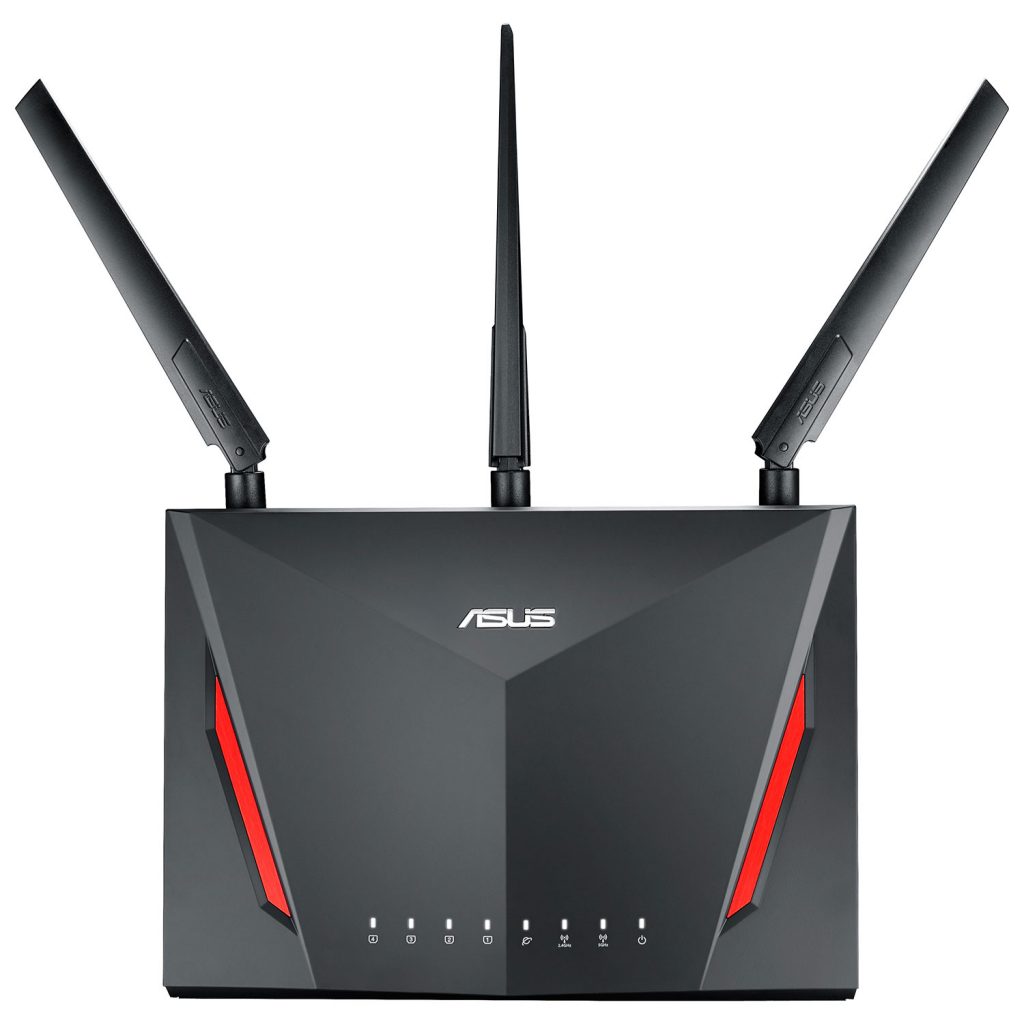
AsusWRT is the stock firmware preinstalled on Asus routers. It supports OpenVPN, L2TP, and PPTP encryption protocols.

Although not as cutting-edge on the software side as Synology, Asus knows hardware. They’ve been a major player in computer hardware since 1989.

ASUS RT-AC86U (AC2900) (1.8 GHz – dual-core) [Amazon]

ASUS RT-AX3000 (1.5 GHz – tri-core) [Amazon]

ASUS RT-AX88U PRO (2.0 GHz – quad-core) [Amazon]

Top Pick: Asus RT-AC86U [Amazon]

Despite its playful exterior meant to appeal to gamers, this is a serious router. It’s powerful enough to cover very large homes and brings cutting-edge tech to the masses.

Asus boasts blistering data transfer speeds of up to 2900 Mbps. The Wi-Fi signal is transmitted dual-band (2.4 + 5 GHz) via the latest 802.11ac MU-MIMO technology. That’s an impressive feat considering the reasonable price point.

Inside there’s a 1.8 GHz dual-core processor, 512 MB of RAM, plus 256 MB of flash storage.

Synology Wi-Fi Routers

Synology is primarily known for its excellent NAS solutions. Nevertheless, the company managed to impress tech enthusiasts with their first router, the RT1900AC, and they’ve built upon that foundation by adding the powerhouse RT2600AC and then the mesh-friendly MR2200AC.

The easy-to-navigate Synology Control Panel allows you to painlessly set up and connect to a VPN service. There is comprehensive protocol support, which includes OpenVPN, PPTP, and L2TP/IPSec.

This interface is like a sleek mini-OS dedicated to your router. And it’s a fresh yet familiar approach.

Synology MR2200AC (717 MHz – quad-core) [Amazon]

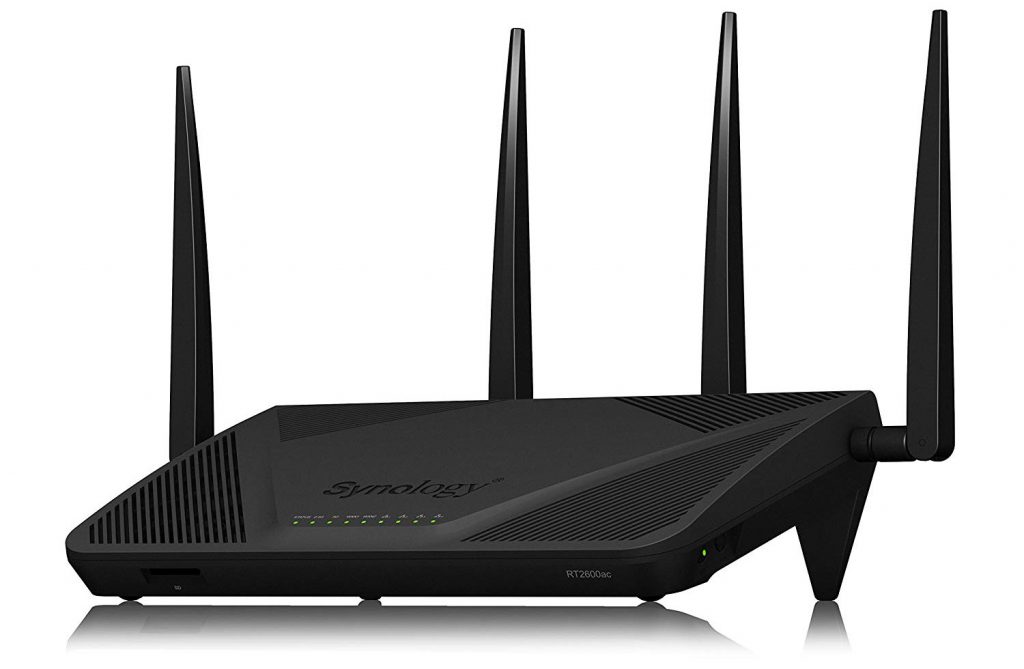
Synology RT2600AC (1.7 GHz – dual-core) [Amazon]

Synology RT6600ax (1.8 GHz – quad-core) [Amazon]

Top Pick: Synology RT2600AC [Amazon]

The RT2600AC is Synology’s former flagship, and it’s now its mid-range offering. This model improves on their first router the RT1900AC in every way. As a formidable unit with four antennas, the gargantuan appearance is matched by solid performance.

Although those who crave AX Wi-Fi speeds should opt for the Synology RT6600ax, most households will be well served by the RT2600AC.

MU-MIMO and the latest 802.11ac Wave 2 standard is supported, giving the router a top speed of 800Mbps and 1733Mbps on the 2.4GHz and 5GHz radios respectively.

It’s powered by a dual-core 1.7 GHz CPU and has 512 MB of DDR3 memory.

Wrapping It Up

Home users are ready for routers with VPN features, but open-source firmware solutions like DD-WRT may not be ready for them. That’s because technical know-how is still needed to gain the rich feature set.

Asus and Synology have managed to balance ease of use with advanced features. So while many are focused on router hardware specs, the importance of superior firmware can’t be ignored.